
Two new transmitters in western France
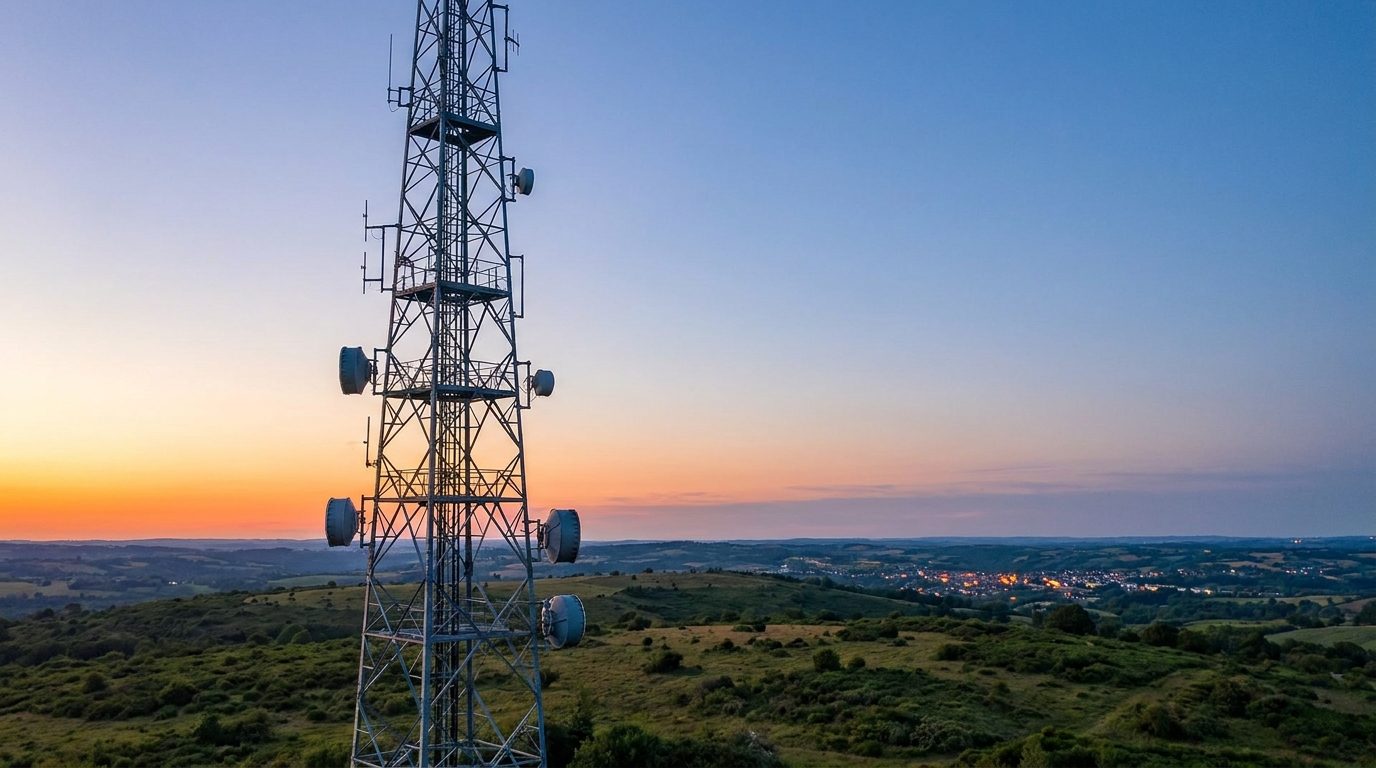
TDF, the operator that broadcasts digital terrestrial television in France, announced on 8 October 2026 that it had switched on two additional zones for its 5G Broadcast trial. The transmitters are located at Haute-Goulaine, near Nantes (Loire-Atlantique), and at Moustoir-Ac, near Vannes (Morbihan). They join the first four zones opened in June 2026 in Paris, Reims, Bourges and Le Havre, bringing the trial to six test zones.
In these two areas, the programmes on air are those of the trial's partners: the France Télévisions channels and NOVO19. TDF has not disclosed the exact extent of the coverage or how many people are able to pick up the signal.
The principle: one signal for everyone
5G Broadcast applies the logic of digital terrestrial TV to mobile devices. A transmitter sends a single stream that is received simultaneously by every compatible device in the area, with no SIM card, no Wi-Fi and no use of the mobile data allowance. Whether a thousand or a million people are tuned in, the load on the network stays the same.
That is the opposite of conventional streaming, where each viewer or listener opens their own connection to a server. According to TDF, this new phase is meant to measure reception quality and service continuity in real-world conditions, to identify what a wider rollout would require, and to prepare other uses: audiovisual content, news, and public warning. Karim El Naggar, CEO of TDF, sums up the goal as building, together with the whole industry, a complementary, accessible and resilient solution to support audiovisual consumption on mobile.
The smartphone is still the bottleneck
A live transmitter is not enough: you also need a phone that can decode the signal. A 5G-capable handset, even a recent one, is not necessarily compatible with 5G Broadcast, which requires specific hardware and software components. In earlier tests, participants used specially equipped smartphones. The 8 October announcement mentions no new consumer model, and while 2027 has already been mentioned as a horizon for the first devices, no commercial timetable has been confirmed.
Nantes is no stranger to the technology: during the Paris Olympic Games in summer 2024, testers there received several TV channels and radio stations on phones configured for the occasion.
What it means for webradios
In the short term, nothing concrete: the trial covers television and no off-the-shelf smartphone can receive these transmissions yet. Audio publishers should still keep an eye on it, for several reasons.
- The cost of audience. A webradio pays for bandwidth per listener: the bigger the audience, the higher the distribution bill. 5G Broadcast works on the opposite model, that of over-the-air broadcasting, with a fixed cost regardless of how many people are listening.
- Access to multiplexes. As with DTT or DAB+, capacity on these networks will be limited and will go through broadcast operators. Large established media will most likely be served first, which would keep the gap with online-only players.
- The battle for mobile. The smartphone is the natural home of webradios. If major media can one day offer free reception there that uses no data, they will have an argument that streaming cannot match.
- Resilience. The public-warning dimension highlighted by TDF is a reminder that broadcast distribution is designed to hold up when data networks are saturated, for example during major events.
For webradios, the strategy therefore remains a multi-platform presence: apps, smart speakers, aggregators and, for those that can afford it, DAB+. 5G Broadcast may one day join that list; until then, TDF's six test zones will provide the first clues about its viability.
Source: The Media Leader FR