

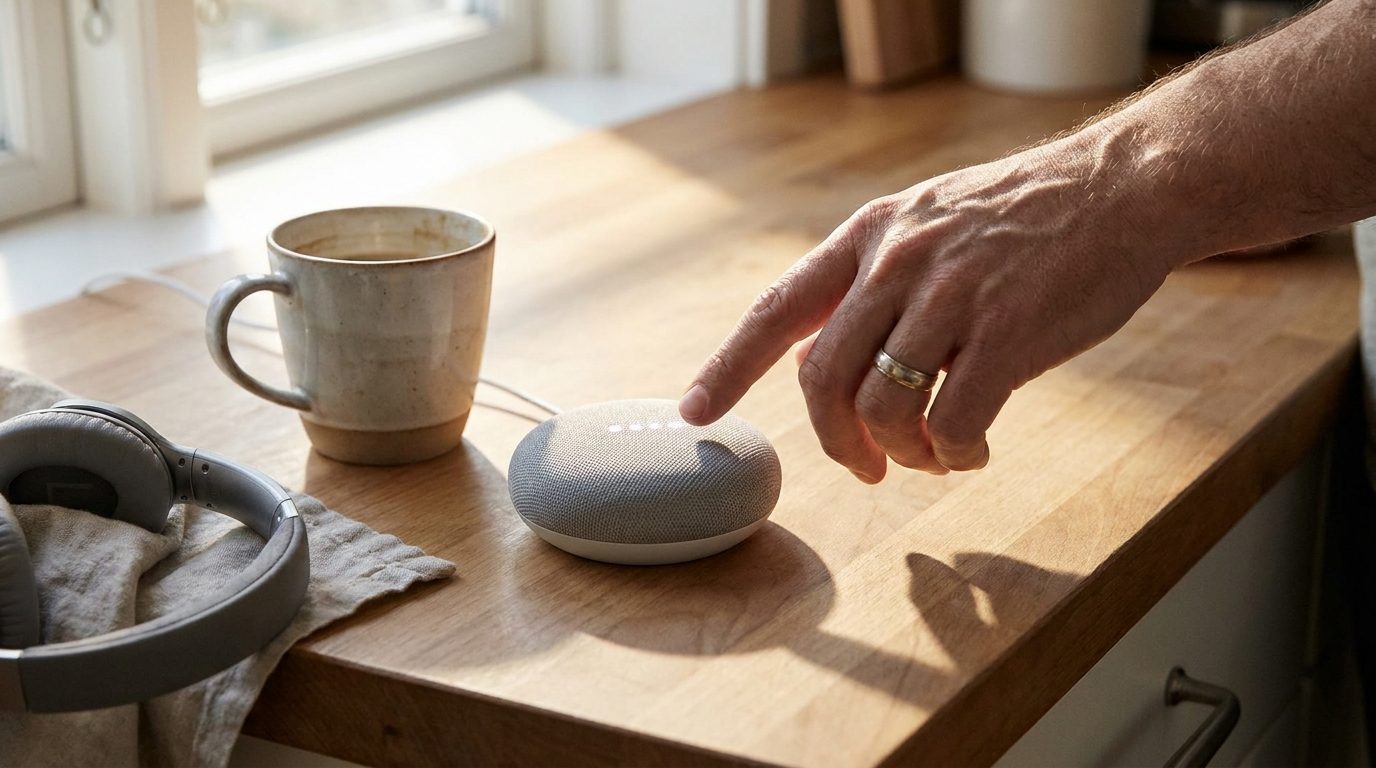
On 13 October 2026, Apple unveiled HomePod mini 2, the new version of its compact smart speaker. It goes on sale in France on Friday 30 October at €169, in five colours. Beyond the hardware refresh, the announcement that matters most to the audio world lies elsewhere: the upcoming arrival of Siri AI, a deeply reworked version of the voice assistant designed to understand more complex requests and sharpen music recommendations.
What Apple is actually announcing
According to Apple's press release, Siri AI runs on an entirely new architecture built on the latest generation of the company's foundation models. The assistant is meant to become more conversational: users will be able to ask follow-up questions and go back and forth, as in a dialogue. Apple highlights three capabilities:
- personal context understanding when the speaker is paired with an Apple Intelligence-enabled iPhone or iPad;
- broad world knowledge, fed by up-to-date information from the web;
- "richer" music discovery, explicitly mentioned by the company.
The speaker can also recognise up to six members of a household by their voice. Even without a compatible iPhone, users will benefit from natural conversations and improved music discovery once Siri AI is enabled. On the hardware side, HomePod mini 2 features the S10 chip, 360-degree sound and a lighting feature called Sound Glow.
A still unclear timeline for France
Enthusiasm should be tempered, however. Siri AI does not ship with the speaker: it will arrive through a future software update, with no precise date. Apple says it will first be available in English, and only in the United States, Australia, Canada, India, New Zealand, Singapore, South Africa and the United Kingdom. No date has been given for a French version. In fact, the French version of the press release does not mention Siri AI at all. French buyers will therefore initially get the classic Siri.
What it means for internet radio stations
For internet radio publishers, the point is less the product itself than the trend it confirms: the way people ask a speaker for audio is changing. With a traditional assistant, listeners have to say the exact name of a station. With a conversational assistant, they will be able to express a mood ("play me a relaxed jazz station" or "a station playing 80s music") and let the machine choose. In that scenario, a station that is not clearly described may simply never be suggested.
A few habits worth adopting right now:
- Polish your description: music genre, tone, language, region, target audience. This is the information assistants can use to answer a vague request.
- Be listed in directories and aggregators with complete, up-to-date profiles, since they often feed connected services.
- Pick a name that is easy to pronounce and recognise by ear, with no ambiguous spelling.
- Offer a reliable, standard stream, available over HTTPS in a widely supported format, so you are not dropped at playback time.
A shift worth watching closely
Apple is not the only player betting on smarter assistants, and the question of radio visibility on smart speakers remains wide open. As long as Siri AI is not available in French, the impact in France will stay limited. But for English-language stations, or those targeting an international audience, the issue could become very real with the next update. Now is a good time to clean up your metadata.
Source: Apple Newsroom