
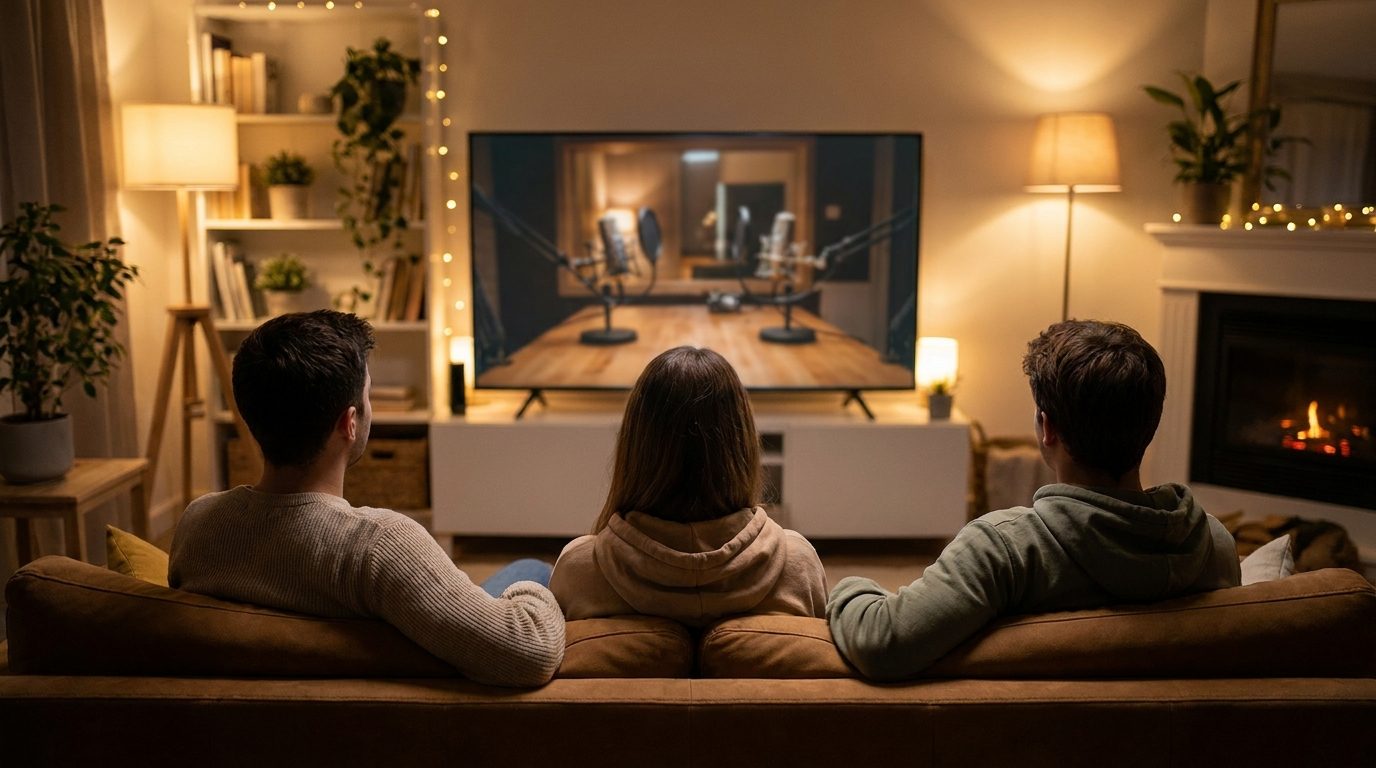
Podcasting is no longer just about earbuds. According to the latest Podcast Compass report from IAB UK, the British trade body for digital advertising, almost three quarters of video podcast consumers in the United Kingdom have already watched a podcast on a television screen. It is a finding that should prompt audio publishers, web radio stations included, to rethink the role of pictures in what they offer.
The TV set becomes a podcast screen
The survey was carried out with research company Walr among 1,029 UK podcast consumers between 30 September and 5 October 2026. The headline result is clear: 74% of people who consume video podcasts have watched them on a TV. The living room is turning into a consumption space in its own right, far from the image of a podcast heard alone on the commute.
This move to the big screen also has a social side. Among those who watch podcasts on television, 37% say they always or often do so with other people. Among 18 to 34-year-olds, that share rises to 52%.
Genre decides the format
The study also shows that the choice between audio and video depends heavily on the type of content. Comedy leans clearly towards video: 41% of respondents prefer it as video, against 24% as audio. News, by contrast, remains largely an audio territory, with 34% preferring audio and 26% video. Politics follows the same pattern: 32% for audio, 22% for video.
For Elizabeth Lane, Head of Insight at IAB UK, these figures reflect very different experiences of the same medium, from listening on headphones during a journey to watching with friends in front of the TV. Her conclusion is that advertisers need to tailor their approach to each situation: a more intimate message around news and politics, a different tone for a comedy show watched as a group.
The full report also looks at creator-led podcasting, programme discovery through social video, advertising measurement and brand partnerships.
What it means for web radio
For a web radio station, these results do not mean everything should be filmed. Rather, they show where pictures add real value and where sound still rules. A few practical ideas:
- Film entertainment shows: a comedy breakfast show or a talk show lends itself well to a video version, published on platforms that can be reached from connected TVs.
- Keep audio at the heart of news: bulletins, debates and political commentary keep an audience that is attached to listening, often more attentively.
- Think about shared viewing: a programme watched by several people in a living room does not have the same pace or tone as content heard alone on headphones.
- Take care of your presence on living-room screens: connected TV apps and video platforms are becoming access points not to be overlooked, including for the live stream.
- Adapt the advertising offer: an advertiser will not necessarily want the same format depending on whether a programme is heard or watched.
Reaching audiences where they are
The study covers the British market, but it illustrates a trend audio publishers are seeing almost everywhere: the line between radio, podcasts and video is blurring. For smaller operators, the challenge is to choose carefully which programmes deserve a video version, without sacrificing what makes online radio strong: closeness, live broadcasting and the human voice.
Source: RadioToday